ExplicitTriangulation is a class that provides time efficient traversal methods on triangulations of piecewise linear manifolds. More...
#include <ExplicitTriangulation.h>
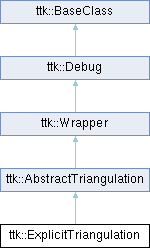
Public Member Functions | |
| ExplicitTriangulation () | |
| ~ExplicitTriangulation () override | |
| ExplicitTriangulation (const ExplicitTriangulation &)=default | |
| ExplicitTriangulation (ExplicitTriangulation &&)=default | |
| ExplicitTriangulation & | operator= (const ExplicitTriangulation &)=default |
| ExplicitTriangulation & | operator= (ExplicitTriangulation &&)=default |
| int | clear () |
| size_t | footprint (size_t size=0) const |
| int | getCellEdgeInternal (const SimplexId &cellId, const int &localEdgeId, SimplexId &edgeId) const override |
| SimplexId | getCellEdgeNumberInternal (const SimplexId &cellId) const override |
| template<std::size_t N> | |
| void | convertToVector (const std::vector< std::array< SimplexId, N > > &table, std::vector< std::vector< SimplexId > > &vec) |
| const std::vector< std::vector< SimplexId > > * | getCellEdgesInternal () override |
| int TTK_TRIANGULATION_INTERNAL | getCellNeighbor (const SimplexId &cellId, const int &localNeighborId, SimplexId &neighborId) const override |
| SimplexId TTK_TRIANGULATION_INTERNAL | getCellNeighborNumber (const SimplexId &cellId) const override |
| const std::vector< std::vector< SimplexId > > *TTK_TRIANGULATION_INTERNAL | getCellNeighbors () override |
| int | getCellTriangleInternal (const SimplexId &cellId, const int &localTriangleId, SimplexId &triangleId) const override |
| SimplexId | getCellTriangleNumberInternal (const SimplexId &cellId) const override |
| const std::vector< std::vector< SimplexId > > * | getCellTrianglesInternal () override |
| int TTK_TRIANGULATION_INTERNAL | getCellVertex (const SimplexId &cellId, const int &localVertexId, SimplexId &vertexId) const override |
| SimplexId TTK_TRIANGULATION_INTERNAL | getCellVertexNumber (const SimplexId &cellId) const override |
| int TTK_TRIANGULATION_INTERNAL | getDimensionality () const override |
| const std::vector< std::array< SimplexId, 2 > > *TTK_TRIANGULATION_INTERNAL | getEdges () override |
| int TTK_TRIANGULATION_INTERNAL | getEdgeLink (const SimplexId &edgeId, const int &localLinkId, SimplexId &linkId) const override |
| SimplexId TTK_TRIANGULATION_INTERNAL | getEdgeLinkNumber (const SimplexId &edgeId) const override |
| const std::vector< std::vector< SimplexId > > *TTK_TRIANGULATION_INTERNAL | getEdgeLinks () override |
| int TTK_TRIANGULATION_INTERNAL | getEdgeStar (const SimplexId &edgeId, const int &localStarId, SimplexId &starId) const override |
| SimplexId TTK_TRIANGULATION_INTERNAL | getEdgeStarNumber (const SimplexId &edgeId) const override |
| const std::vector< std::vector< SimplexId > > *TTK_TRIANGULATION_INTERNAL | getEdgeStars () override |
| int | getEdgeTriangleInternal (const SimplexId &edgeId, const int &localTriangleId, SimplexId &triangleId) const override |
| SimplexId | getEdgeTriangleNumberInternal (const SimplexId &edgeId) const override |
| const std::vector< std::vector< SimplexId > > * | getEdgeTrianglesInternal () override |
| int | getEdgeVertexInternal (const SimplexId &edgeId, const int &localVertexId, SimplexId &vertexId) const override |
| SimplexId TTK_TRIANGULATION_INTERNAL | getNumberOfCells () const override |
| SimplexId | getNumberOfEdgesInternal () const override |
| SimplexId | getNumberOfTrianglesInternal () const override |
| SimplexId TTK_TRIANGULATION_INTERNAL | getNumberOfVertices () const override |
| const std::vector< std::array< SimplexId, 3 > > *TTK_TRIANGULATION_INTERNAL | getTriangles () override |
| int | getTriangleEdgeInternal (const SimplexId &triangleId, const int &localEdgeId, SimplexId &edgeId) const override |
| SimplexId | getTriangleEdgeNumberInternal (const SimplexId &triangleId) const override |
| const std::vector< std::vector< SimplexId > > * | getTriangleEdgesInternal () override |
| int TTK_TRIANGULATION_INTERNAL | getTriangleLink (const SimplexId &triangleId, const int &localLinkId, SimplexId &linkId) const override |
| SimplexId TTK_TRIANGULATION_INTERNAL | getTriangleLinkNumber (const SimplexId &triangleId) const override |
| const std::vector< std::vector< SimplexId > > *TTK_TRIANGULATION_INTERNAL | getTriangleLinks () override |
| int TTK_TRIANGULATION_INTERNAL | getTriangleStar (const SimplexId &triangleId, const int &localStarId, SimplexId &starId) const override |
| SimplexId TTK_TRIANGULATION_INTERNAL | getTriangleStarNumber (const SimplexId &triangleId) const override |
| const std::vector< std::vector< SimplexId > > *TTK_TRIANGULATION_INTERNAL | getTriangleStars () override |
| int | getTriangleVertexInternal (const SimplexId &triangleId, const int &localVertexId, SimplexId &vertexId) const override |
| int | getVertexEdgeInternal (const SimplexId &vertexId, const int &localEdgeId, SimplexId &edgeId) const override |
| SimplexId | getVertexEdgeNumberInternal (const SimplexId &vertexId) const override |
| const std::vector< std::vector< SimplexId > > * | getVertexEdgesInternal () override |
| int TTK_TRIANGULATION_INTERNAL | getVertexLink (const SimplexId &vertexId, const int &localLinkId, SimplexId &linkId) const override |
| SimplexId TTK_TRIANGULATION_INTERNAL | getVertexLinkNumber (const SimplexId &vertexId) const override |
| const std::vector< std::vector< SimplexId > > *TTK_TRIANGULATION_INTERNAL | getVertexLinks () override |
| int TTK_TRIANGULATION_INTERNAL | getVertexNeighbor (const SimplexId &vertexId, const int &localNeighborId, SimplexId &neighborId) const override |
| SimplexId TTK_TRIANGULATION_INTERNAL | getVertexNeighborNumber (const SimplexId &vertexId) const override |
| const std::vector< std::vector< SimplexId > > *TTK_TRIANGULATION_INTERNAL | getVertexNeighbors () override |
| int TTK_TRIANGULATION_INTERNAL | getVertexPoint (const SimplexId &vertexId, float &x, float &y, float &z) const override |
| int TTK_TRIANGULATION_INTERNAL | getVertexStar (const SimplexId &vertexId, const int &localStarId, SimplexId &starId) const override |
| SimplexId TTK_TRIANGULATION_INTERNAL | getVertexStarNumber (const SimplexId &vertexId) const override |
| const std::vector< std::vector< SimplexId > > *TTK_TRIANGULATION_INTERNAL | getVertexStars () override |
| int | getVertexTriangleInternal (const SimplexId &vertexId, const int &localTriangleId, SimplexId &triangleId) const override |
| SimplexId | getVertexTriangleNumberInternal (const SimplexId &vertexId) const override |
| const std::vector< std::vector< SimplexId > > * | getVertexTrianglesInternal () override |
| bool TTK_TRIANGULATION_INTERNAL | isEdgeOnBoundary (const SimplexId &edgeId) const override |
| bool | isEmpty () const override |
| bool TTK_TRIANGULATION_INTERNAL | isTriangleOnBoundary (const SimplexId &triangleId) const override |
| bool TTK_TRIANGULATION_INTERNAL | isVertexOnBoundary (const SimplexId &vertexId) const override |
| int | preconditionBoundaryEdgesInternal () override |
| int | preconditionBoundaryTrianglesInternal () override |
| int | preconditionBoundaryVerticesInternal () override |
| int | preconditionCellEdgesInternal () override |
| int | preconditionCellNeighborsInternal () override |
| int | preconditionCellTrianglesInternal () override |
| int | preconditionEdgesInternal () override |
| int | preconditionEdgeLinksInternal () override |
| int | preconditionEdgeStarsInternal () override |
| int | preconditionEdgeTrianglesInternal () override |
| int | preconditionTrianglesInternal () override |
| int | preconditionTriangleEdgesInternal () override |
| int | preconditionTriangleLinksInternal () override |
| int | preconditionTriangleStarsInternal () override |
| int | preconditionVertexEdgesInternal () override |
| int | preconditionVertexLinksInternal () override |
| int | preconditionVertexNeighborsInternal () override |
| int | preconditionVertexStarsInternal () override |
| int | preconditionVertexTrianglesInternal () override |
| int | preconditionManifoldInternal () override |
| int | setInputCells (const SimplexId &cellNumber, const LongSimplexId *cellArray) |
| int | setInputPoints (const SimplexId &pointNumber, const void *pointSet, const bool &doublePrecision=false) |
| int | writeToFile (std::ofstream &stream) const |
| Write internal state to disk. | |
| int | writeToFileASCII (std::ofstream &stream) const |
| Write internal state to disk using an ASCII format. | |
| int | readFromFile (std::ifstream &stream) |
| Read from disk into internal state. | |
| Public Member Functions inherited from ttk::AbstractTriangulation | |
| AbstractTriangulation () | |
| ~AbstractTriangulation () override | |
| AbstractTriangulation (const AbstractTriangulation &)=default | |
| AbstractTriangulation (AbstractTriangulation &&)=default | |
| AbstractTriangulation & | operator= (const AbstractTriangulation &)=default |
| AbstractTriangulation & | operator= (AbstractTriangulation &&)=default |
| int | clear () |
| size_t | footprint (size_t size=0) const |
| virtual int | getCellEdge (const SimplexId &cellId, const int &localEdgeId, SimplexId &edgeId) const |
| virtual SimplexId | getCellEdgeNumber (const SimplexId &cellId) const |
| virtual const std::vector< std::vector< SimplexId > > * | getCellEdges () |
| virtual int | getCellTriangle (const SimplexId &cellId, const int &localTriangleId, SimplexId &triangleId) const |
| virtual SimplexId | getCellTriangleNumber (const SimplexId &cellId) const |
| virtual const std::vector< std::vector< SimplexId > > * | getCellTriangles () |
| virtual int | getEdgeTriangle (const SimplexId &edgeId, const int &localTriangleId, SimplexId &triangleId) const |
| virtual SimplexId | getEdgeTriangleNumber (const SimplexId &edgeId) const |
| virtual const std::vector< std::vector< SimplexId > > * | getEdgeTriangles () |
| virtual int | getEdgeVertex (const SimplexId &edgeId, const int &localVertexId, SimplexId &vertexId) const |
| int | getEdgeVertexNumber (const SimplexId ttkNotUsed(edgeId)) const |
| virtual const std::array< SimplexId, 3 > & | getGridDimensions () const |
| virtual SimplexId | getNumberOfEdges () const |
| virtual SimplexId | getNumberOfTriangles () const |
| virtual int | getTriangleEdge (const SimplexId &triangleId, const int &localEdgeId, SimplexId &edgeId) const |
| virtual SimplexId | getTriangleEdgeNumber (const SimplexId &triangleId) const |
| virtual const std::vector< std::vector< SimplexId > > * | getTriangleEdges () |
| virtual int | getTriangleVertex (const SimplexId &triangleId, const int &localVertexId, SimplexId &vertexId) const |
| int | getTriangleVertexNumber (const SimplexId ttkNotUsed(triangleId)) const |
| virtual int | getVertexEdge (const SimplexId &vertexId, const int &localEdgeId, SimplexId &edgeId) const |
| virtual SimplexId | getVertexEdgeNumber (const SimplexId &vertexId) const |
| virtual const std::vector< std::vector< SimplexId > > * | getVertexEdges () |
| virtual int | getVertexTriangle (const SimplexId &vertexId, const int &localTriangleId, SimplexId &triangleId) const |
| virtual SimplexId | getVertexTriangleNumber (const SimplexId &vertexId) const |
| virtual const std::vector< std::vector< SimplexId > > * | getVertexTriangles () |
| bool | hasPeriodicBoundaries () const |
| Returns true if the grid uses period boundary conditions. | |
| virtual bool | isManifold () const |
| virtual int | preconditionManifold () |
| virtual int | preconditionBoundaryEdges () |
| virtual int | preconditionBoundaryTriangles () |
| virtual int | preconditionBoundaryVertices () |
| virtual int | preconditionCellEdges () |
| virtual int | preconditionCellNeighbors () |
| virtual int | preconditionCellTriangles () |
| virtual int | preconditionEdges () |
| virtual int | preconditionEdgeLinks () |
| virtual int | preconditionEdgeStars () |
| virtual int | preconditionEdgeTriangles () |
| virtual int | preconditionTriangles () |
| virtual int | preconditionTriangleEdges () |
| virtual int | preconditionTriangleLinks () |
| virtual int | preconditionTriangleStars () |
| virtual int | preconditionVertexEdges () |
| virtual int | preconditionVertexLinks () |
| virtual int | preconditionVertexNeighbors () |
| virtual int | preconditionVertexStars () |
| virtual int | preconditionVertexTriangles () |
| int | getEdgeIncenter (const SimplexId edgeId, float incenter[3]) const |
| int | getTriangleIncenter (const SimplexId triangleId, float incenter[3]) const |
| int | getTetraIncenter (const SimplexId tetraId, float incenter[3]) const |
| int | getCellIncenter (const SimplexId cellid, const int dim, float incenter[3]) const |
| virtual int | getCellVTKID (const int &ttkId, int &vtkId) const |
| template<class itemType> | |
| size_t | tableTableFootprint (const vector< vector< itemType > > &table, const string &tableName, ostream &stream) const |
| Public Member Functions inherited from ttk::Wrapper | |
| Wrapper () | |
| ~Wrapper () override=default | |
| virtual int | updateProgress (const float &progress)=0 |
| Public Member Functions inherited from ttk::Debug | |
| Debug () | |
| ~Debug () override | |
| virtual int | setDebugLevel (const int &debugLevel) |
| int | setWrapper (const Wrapper *wrapper) override |
| int | printMsg (const std::string &msg, const debug::Priority &priority=debug::Priority::INFO, const debug::LineMode &lineMode=debug::LineMode::NEW, std::ostream &stream=std::cout) const |
| int | printMsg (const std::vector< std::string > &msgs, const debug::Priority &priority=debug::Priority::INFO, const debug::LineMode &lineMode=debug::LineMode::NEW, std::ostream &stream=std::cout) const |
| int | printErr (const std::string &msg, const debug::LineMode &lineMode=debug::LineMode::NEW, std::ostream &stream=std::cerr) const |
| int | printWrn (const std::string &msg, const debug::LineMode &lineMode=debug::LineMode::NEW, std::ostream &stream=std::cerr) const |
| int | printMsg (const std::string &msg, const double &progress, const double &time, const int &threads, const double &memory, const debug::LineMode &lineMode=debug::LineMode::NEW, const debug::Priority &priority=debug::Priority::PERFORMANCE, std::ostream &stream=std::cout) const |
| int | printMsg (const std::string &msg, const double &progress, const double &time, const debug::LineMode &lineMode=debug::LineMode::NEW, const debug::Priority &priority=debug::Priority::PERFORMANCE, std::ostream &stream=std::cout) const |
| int | printMsg (const std::string &msg, const double &progress, const double &time, const int &threads, const debug::LineMode &lineMode=debug::LineMode::NEW, const debug::Priority &priority=debug::Priority::PERFORMANCE, std::ostream &stream=std::cout) const |
| int | printMsg (const std::string &msg, const double &progress, const debug::LineMode &lineMode=debug::LineMode::NEW, const debug::Priority &priority=debug::Priority::PERFORMANCE, std::ostream &stream=std::cout) const |
| int | printMsg (const std::string &msg, const double &progress, const debug::Priority &priority, const debug::LineMode &lineMode=debug::LineMode::NEW, std::ostream &stream=std::cout) const |
| int | printMsg (const std::vector< std::vector< std::string > > &rows, const debug::Priority &priority=debug::Priority::INFO, const bool hasHeader=true, const debug::LineMode &lineMode=debug::LineMode::NEW, std::ostream &stream=std::cout) const |
| int | printMsg (const debug::Separator &separator, const debug::LineMode &lineMode=debug::LineMode::NEW, const debug::Priority &priority=debug::Priority::INFO, std::ostream &stream=std::cout) const |
| int | printMsg (const debug::Separator &separator, const debug::Priority &priority, const debug::LineMode &lineMode=debug::LineMode::NEW, std::ostream &stream=std::cout) const |
| int | printMsg (const std::string &msg, const debug::Separator &separator, const debug::LineMode &lineMode=debug::LineMode::NEW, const debug::Priority &priority=debug::Priority::INFO, std::ostream &stream=std::cout) const |
| void | setDebugMsgPrefix (const std::string &prefix) |
| Public Member Functions inherited from ttk::BaseClass | |
| BaseClass () | |
| virtual | ~BaseClass ()=default |
| int | getThreadNumber () const |
| virtual int | setThreadNumber (const int threadNumber) |
Detailed Description
ExplicitTriangulation is a class that provides time efficient traversal methods on triangulations of piecewise linear manifolds.
- Date
- January 2016.
- See also
- Triangulation
Definition at line 21 of file ExplicitTriangulation.h.
Constructor & Destructor Documentation
◆ ExplicitTriangulation() [1/3]
| ExplicitTriangulation::ExplicitTriangulation | ( | ) |
Definition at line 13 of file ExplicitTriangulation.cpp.
◆ ~ExplicitTriangulation()
|
overridedefault |
◆ ExplicitTriangulation() [2/3]
|
default |
◆ ExplicitTriangulation() [3/3]
|
default |
Member Function Documentation
◆ clear()
| int ExplicitTriangulation::clear | ( | ) |
Definition at line 22 of file ExplicitTriangulation.cpp.
◆ convertToVector()
|
inline |
Definition at line 63 of file ExplicitTriangulation.h.
◆ footprint()
| size_t ExplicitTriangulation::footprint | ( | size_t | size = 0 | ) | const |
Definition at line 32 of file ExplicitTriangulation.cpp.
◆ getCellEdgeInternal()
|
inlineoverride |
Definition at line 37 of file ExplicitTriangulation.h.
◆ getCellEdgeNumberInternal()
|
inlineoverride |
Definition at line 53 of file ExplicitTriangulation.h.
◆ getCellEdgesInternal()
|
inlineoverridevirtual |
Reimplemented from ttk::AbstractTriangulation.
Definition at line 71 of file ExplicitTriangulation.h.
◆ getCellNeighbor()
|
inlineoverridevirtual |
Get the localNeighborId-th cell neighbor of the cellId-th cell.
Here the notion of cell refers to the simplicices of maximal dimension (3D: tetrahedra, 2D: triangles, 1D: edges).
- Precondition
- For this function to behave correctly, preconditionCellNeighbors() needs to be called on this object prior to any traversal, in a clearly distinct pre-processing step that involves no traversal at all. An error will be returned otherwise.
- Note
- It is recommended to exclude such a preconditioning step from any time performance measurement.
- Parameters
-
cellId Input global cell identifier. localNeighborId Input local neighbor identifier, in [0, getCellNeighborNumber()]. neighborId Output global neighbor cell identifier.
- Returns
- Returns 0 upon success, negative values otherwise.
- See also
- getCellNeighborNumber()
Reimplemented from ttk::AbstractTriangulation.
Definition at line 77 of file ExplicitTriangulation.h.
◆ getCellNeighborNumber()
|
inlineoverridevirtual |
Get the number of cell neighbors for the cellId-th cell.
Here the notion of cell refers to the simplicices of maximal dimension (3D: tetrahedra, 2D: triangles, 1D: edges).
- Precondition
- For this function to behave correctly, preconditionCellNeighbors() needs to be called on this object prior to any traversal, in a clearly distinct pre-processing step that involves no traversal at all. An error will be returned otherwise.
- Note
- It is recommended to exclude such a preconditioning step from any time performance measurement.
- Parameters
-
cellId Input global cell identifier.
- Returns
- Returns the number of cell neighbors.
Reimplemented from ttk::AbstractTriangulation.
Definition at line 86 of file ExplicitTriangulation.h.
◆ getCellNeighbors()
|
inlineoverridevirtual |
- Warning
- YOU SHOULD NOT CALL THIS FUNCTION UNLESS YOU REALLY KNOW WHAT YOU ARE DOING.
Get the list of cell neighbors for all cells.
Here the notion of cell refers to the simplicices of maximal dimension (3D: tetrahedra, 2D: triangles, 1D: edges).
The number of entries in this list is equal to the number of cells. Each entry is a std::vector of identifiers whose size is equal to the number of neighbor cells for the corresponding cell.
In implicit mode, this function will force the creation of such a list (which will be time and memory consuming). THIS IS USUALLY A BAD IDEA.
- Precondition
- For this function to behave correctly, preconditionCellNeighbors() needs to be called on this object prior to any traversal, in a clearly distinct pre-processing step that involves no traversal at all. An error will be returned otherwise.
- Note
- It is recommended to exclude such a preconditioning step from any time performance measurement.
- Returns
- Returns a pointer to the cell neighbor list.
Reimplemented from ttk::AbstractTriangulation.
Definition at line 92 of file ExplicitTriangulation.h.
◆ getCellTriangleInternal()
|
inlineoverride |
Definition at line 97 of file ExplicitTriangulation.h.
◆ getCellTriangleNumberInternal()
|
inlineoverride |
Definition at line 114 of file ExplicitTriangulation.h.
◆ getCellTrianglesInternal()
|
inlineoverridevirtual |
Reimplemented from ttk::AbstractTriangulation.
Definition at line 125 of file ExplicitTriangulation.h.
◆ getCellVertex()
|
inlineoverridevirtual |
Get the localVertexId-th vertex identifier of the cellId-th cell.
Here the notion of cell refers to the simplicices of maximal dimension (3D: tetrahedra, 2D: triangles, 1D: edges).
- Parameters
-
cellId Input global cell identifier. localVertexId Input local vertex identifier, in [0, getCellVertexNumber()]. vertexId Output global vertex identifier.
- Returns
- Returns 0 upon success, negative values otherwise.
- See also
- getCellVertexNumber()
Reimplemented from ttk::AbstractTriangulation.
Definition at line 131 of file ExplicitTriangulation.h.
◆ getCellVertexNumber()
|
inlineoverridevirtual |
Get the number of vertices in a cell.
Here the notion of cell refers to the simplicices of maximal dimension (3D: tetrahedra, 2D: triangles, 1D: edges).
- Parameters
-
cellId Input global cell identifier.
- Returns
- Number of vertices in the cell.
Reimplemented from ttk::AbstractTriangulation.
Definition at line 143 of file ExplicitTriangulation.h.
◆ getDimensionality()
|
inlineoverridevirtual |
Get the dimensionality of the triangulation (this value is equal to the dimension of the simplex with largest dimensionality).
- Returns
- Returns the dimensionality of the triangulation.
Reimplemented from ttk::AbstractTriangulation.
Definition at line 152 of file ExplicitTriangulation.h.
◆ getEdgeLink()
|
inlineoverridevirtual |
Get the localLinkId-th simplex of the link of the edgeId-th edge.
The output linkId refers in 2D to a vertex identifier and in 3D to an edge identifier. It returns a negative value in 1D.
- Precondition
- For this function to behave correctly, preconditionEdgeLinks() needs to be called on this object prior to any traversal, in a clearly distinct pre-processing step that involves no traversal at all. An error will be returned otherwise.
- Note
- It is recommended to exclude such a preconditioning step from any time performance measurement.
- Parameters
-
edgeId Input global edge identifier. localLinkId Input local link simplex identifier, in [0, getEdgeLinkNumber()]. linkId Output link simplex identifier.
- Returns
- Returns 0 upon success, negative values otherwise.
- See also
- getEdgeLinkNumber()
Reimplemented from ttk::AbstractTriangulation.
Definition at line 161 of file ExplicitTriangulation.h.
◆ getEdgeLinkNumber()
|
inlineoverridevirtual |
Get the number of simplicies in the link of the edgeId-th edge.
In 2D, this will return the number of vertices in the link, in 3D the number of edges. It returns a negative value in 1D.
- Precondition
- For this function to behave correctly, preconditionEdgeLinks() needs to be called on this object prior to any traversal, in a clearly distinct pre-processing step that involves no traversal at all. An error will be returned otherwise.
- Note
- It is recommended to exclude such a preconditioning step from any time performance measurement.
- Parameters
-
edgeId Input global edge identifier.
- Returns
- Returns the number of cells in the link of the edge.
Reimplemented from ttk::AbstractTriangulation.
Definition at line 170 of file ExplicitTriangulation.h.
◆ getEdgeLinks()
|
inlineoverridevirtual |
- Warning
- YOU SHOULD NOT CALL THIS FUNCTION UNLESS YOU REALLY KNOW WHAT YOU ARE DOING.
Get the list of link simplices for all edges.
The number of entries in this list is equal to the number of edges. Each entry is a std::vector of identifiers representing vertices in 2D and edges in 3D. It returns NULL in 1D.
In implicit mode, this function will force the creation of such a list (which will be time and memory consuming). THIS IS USUALLY A BAD IDEA.
- Precondition
- For this function to behave correctly, preconditionEdgeLinks() needs to be called on this object prior to any traversal, in a clearly distinct pre-processing step that involves no traversal at all. An error will be returned otherwise.
- Note
- It is recommended to exclude such a preconditioning step from any time performance measurement.
- Returns
- Returns a pointer to the edge link list.
Reimplemented from ttk::AbstractTriangulation.
Definition at line 176 of file ExplicitTriangulation.h.
◆ getEdges()
|
inlineoverridevirtual |
- Warning
- YOU SHOULD NOT CALL THIS FUNCTION UNLESS YOU REALLY KNOW WHAT YOU ARE DOING.
Get the list of edges of the triangulation.
Here the notion of edge only makes sense if the triangulation has a dimension greater than 1 (otherwise, use the cell information).
The number of entries in this list is equal to the number of edges. Each entry is a std::pair of vertex identifiers.
In implicit mode, this function will force the creation of such a list (which will be time and memory consuming). THIS IS USUALLY A BAD IDEA.
- Precondition
- For this function to behave correctly, preconditionEdges() needs to be called on this object prior to any traversal, in a clearly distinct pre-processing step that involves no traversal at all. An error will be returned otherwise.
- Note
- It is recommended to exclude such a preconditioning step from any time performance measurement.
- Returns
- Returns a pointer to the edge list.
Reimplemented from ttk::AbstractTriangulation.
Definition at line 157 of file ExplicitTriangulation.h.
◆ getEdgeStar()
|
inlineoverridevirtual |
Get the localStarId-th cell of the star of the edgeId-th edge.
Here the notion of cell refers to the simplicices of maximal dimension (3D: tetrahedra, 2D: triangles, 1D: edges).
Also, the notion of edge only makes sense if the triangulation has a dimension greater than 1 (otherwise, use the cell information).
- Precondition
- For this function to behave correctly, preconditionEdgeStars() needs to be called on this object prior to any traversal, in a clearly distinct pre-processing step that involves no traversal at all. An error will be returned otherwise.
- Note
- It is recommended to exclude such a preconditioning step from any time performance measurement.
- Parameters
-
edgeId Input global edge identifier. localStarId Input local star cell identifier, in [0, getEdgeStarNumber()]. starId Output global star cell identifier.
- Returns
- Returns 0 upon success, negative values otherwise.
- See also
- getEdgeStarNumber()
Reimplemented from ttk::AbstractTriangulation.
Definition at line 181 of file ExplicitTriangulation.h.
◆ getEdgeStarNumber()
|
inlineoverridevirtual |
Get the number of star cells for the edgeId-th edge.
Here the notion of cell refers to the simplicices of maximal dimension (3D: tetrahedra, 2D: triangles, 1D: edges).
Also, the notion of edge only makes sense if the triangulation has a dimension greater than 1 (otherwise, use the cell information).
- Precondition
- For this function to behave correctly, preconditionEdgeStars() needs to be called on this object prior to any traversal, in a clearly distinct pre-processing step that involves no traversal at all. An error will be returned otherwise.
- Note
- It is recommended to exclude such a preconditioning step from any time performance measurement.
- Parameters
-
edgeId Input global edge identifier
- Returns
- Returns the number of star cells.
Reimplemented from ttk::AbstractTriangulation.
Definition at line 190 of file ExplicitTriangulation.h.
◆ getEdgeStars()
|
inlineoverridevirtual |
- Warning
- YOU SHOULD NOT CALL THIS FUNCTION UNLESS YOU REALLY KNOW WHAT YOU ARE DOING.
Get the list of star cell identifiers for all edges.
Here the notion of cell refers to the simplicices of maximal dimension (3D: tetrahedra, 2D: triangles, 1D: edges).
Also, the notion of edge only makes sense if the triangulation has a dimension greater than 1 (otherwise, use the cell information).
The number of entries in this list is equal to the number of edges. Each entry is a std::vector of identifiers whose size is equal to the number of star cells for the corresponding edge.
In implicit mode, this function will force the creation of such a list (which will be time and memory consuming). THIS IS USUALLY A BAD IDEA.
- Precondition
- For this function to behave correctly, preconditionEdgeStars() needs to be called on this object prior to any traversal, in a clearly distinct pre-processing step that involves no traversal at all. An error will be returned otherwise.
- Note
- It is recommended to exclude such a preconditioning step from any time performance measurement.
- Returns
- Returns a pointer to the edge star list.
Reimplemented from ttk::AbstractTriangulation.
Definition at line 196 of file ExplicitTriangulation.h.
◆ getEdgeTriangleInternal()
|
inlineoverride |
Definition at line 201 of file ExplicitTriangulation.h.
◆ getEdgeTriangleNumberInternal()
|
inlineoverride |
Definition at line 209 of file ExplicitTriangulation.h.
◆ getEdgeTrianglesInternal()
|
inlineoverridevirtual |
Reimplemented from ttk::AbstractTriangulation.
Definition at line 214 of file ExplicitTriangulation.h.
◆ getEdgeVertexInternal()
|
inlineoverride |
Definition at line 219 of file ExplicitTriangulation.h.
◆ getNumberOfCells()
|
inlineoverridevirtual |
Get the number of cells in the triangulation.
Here the notion of cell refers to the simplicices of maximal dimension (3D: tetrahedra, 2D: triangles, 1D: edges).
- Returns
- Returns the number of cells.
Reimplemented from ttk::AbstractTriangulation.
Definition at line 236 of file ExplicitTriangulation.h.
◆ getNumberOfEdgesInternal()
|
inlineoverridevirtual |
Reimplemented from ttk::AbstractTriangulation.
Definition at line 240 of file ExplicitTriangulation.h.
◆ getNumberOfTrianglesInternal()
|
inlineoverridevirtual |
Reimplemented from ttk::AbstractTriangulation.
Definition at line 244 of file ExplicitTriangulation.h.
◆ getNumberOfVertices()
|
inlineoverridevirtual |
Get the number of vertices in the triangulation.
- Returns
- Returns the number of vertices.
Reimplemented from ttk::AbstractTriangulation.
Definition at line 249 of file ExplicitTriangulation.h.
◆ getTriangleEdgeInternal()
|
inlineoverride |
Definition at line 258 of file ExplicitTriangulation.h.
◆ getTriangleEdgeNumberInternal()
|
inlineoverride |
Definition at line 275 of file ExplicitTriangulation.h.
◆ getTriangleEdgesInternal()
|
inlineoverridevirtual |
Reimplemented from ttk::AbstractTriangulation.
Definition at line 288 of file ExplicitTriangulation.h.
◆ getTriangleLink()
|
inlineoverridevirtual |
Get the localLinkId-th simplex of the link of the triangleId-th triangle.
The notion of triangle link only makes sense in 3D, where the output linkId refers to a vertex identifier.
- Precondition
- For this function to behave correctly, preconditionTriangleLinks() needs to be called on this object prior to any traversal, in a clearly distinct pre-processing step that involves no traversal at all. An error will be returned otherwise.
- Note
- It is recommended to exclude such a preconditioning step from any time performance measurement.
- Parameters
-
triangleId Input global triangle identifier. localLinkId Input local link simplex identifier, in [0, getTriangleLinkNumber()]. linkId Output link simplex identifier.
- Returns
- Returns 0 upon success, negative values otherwise.
- See also
- getTriangleLinkNumber()
Reimplemented from ttk::AbstractTriangulation.
Definition at line 294 of file ExplicitTriangulation.h.
◆ getTriangleLinkNumber()
|
inlineoverridevirtual |
Get the number of simplices in the link of the triangleId-th triangle.
The notion of triangle link only makes sense in 3D, where the number of vertices in the link will be returned.
- Precondition
- For this function to behave correctly, preconditionTriangleLinks() needs to be called on this object prior to any traversal, in a clearly distinct pre-processing step that involves no traversal at all. An error will be returned otherwise.
- Note
- It is recommended to exclude such a preconditioning step from any time performance measurement.
- Parameters
-
triangleId Input global triangle identifier.
- Returns
- Returns the number of simplices in the link of the triangle.
Reimplemented from ttk::AbstractTriangulation.
Definition at line 303 of file ExplicitTriangulation.h.
◆ getTriangleLinks()
|
inlineoverridevirtual |
- Warning
- YOU SHOULD NOT CALL THIS FUNCTION UNLESS YOU REALLY KNOW WHAT YOU ARE DOING.
Get the list of link simplices for all triangles.
The number of entries in this list is equal to the number of triangles. Each entry is a std::vector of identifiers representing a vertex.
The notion of triangle link only makes sense in 3D.
In implicit mode, this function will force the creation of such a list (which will be time and memory consuming). THIS IS USUALLY A BAD IDEA.
- Precondition
- For this function to behave correctly, preconditionTriangleLinks() needs to be called on this object prior to any traversal, in a clearly distinct pre-processing step that involves no traversal at all. An error will be returned otherwise.
- Note
- It is recommended to exclude such a preconditioning step from any time performance measurement.
- Returns
- Returns a pointer to the triangle link list.
Reimplemented from ttk::AbstractTriangulation.
Definition at line 309 of file ExplicitTriangulation.h.
◆ getTriangles()
|
inlineoverridevirtual |
- Warning
- YOU SHOULD NOT CALL THIS FUNCTION UNLESS YOU REALLY KNOW WHAT YOU ARE DOING.
Get the list of triangles of the triangulation.
Here the notion of triangle only makes sense if the triangulation has a dimension greater than 2 (otherwise, use the cell information).
The number of entries in this list is equal to the number of triangles. Each entry is a std::vector of vertex identifiers.
In implicit mode, this function will force the creation of such a list (which will be time and memory consuming). THIS IS USUALLY A BAD IDEA.
- Precondition
- For this function to behave correctly, preconditionTriangles() needs to be called on this object prior to any traversal, in a clearly distinct pre-processing step that involves no traversal at all. An error will be returned otherwise.
- Note
- It is recommended to exclude such a preconditioning step from any time performance measurement.
- Returns
- Returns a pointer to the triangle list.
Reimplemented from ttk::AbstractTriangulation.
Definition at line 254 of file ExplicitTriangulation.h.
◆ getTriangleStar()
|
inlineoverridevirtual |
Get the localStarId-th cell of the star of the triangleId-th triangle.
The notion of triangle star only makes sense in 3D, where the output starId refers to a tetrahedron identifier.
- Precondition
- For this function to behave correctly, preconditionTriangleStars() needs to be called on this object prior to any traversal, in a clearly distinct pre-processing step that involves no traversal at all. An error will be returned otherwise.
- Note
- It is recommended to exclude such a preconditioning step from any time performance measurement.
- Parameters
-
triangleId Input global triangle identifier. localStarId Input local star cell identifier, in [0, getTriangleStarNumber()]. starId Output global star cell identifier.
- Returns
- Returns 0 upon success, negative values otherwise.
- See also
- getTriangleStarNumber()
Reimplemented from ttk::AbstractTriangulation.
Definition at line 314 of file ExplicitTriangulation.h.
◆ getTriangleStarNumber()
|
inlineoverridevirtual |
Get the number of star cells for the triangleId-th triangle.
The notion of triangle star only makes sense in 3D, where the number of tetrahedra in the star will be returned.
- Precondition
- For this function to behave correctly, preconditionTriangleStars() needs to be called on this object prior to any traversal, in a clearly distinct pre-processing step that involves no traversal at all. An error will be returned otherwise.
- Note
- It is recommended to exclude such a preconditioning step from any time performance measurement.
- Parameters
-
triangleId Input global triangle identifier.
- Returns
- Returns the number of star cells.
Reimplemented from ttk::AbstractTriangulation.
Definition at line 322 of file ExplicitTriangulation.h.
◆ getTriangleStars()
|
inlineoverridevirtual |
- Warning
- YOU SHOULD NOT CALL THIS FUNCTION UNLESS YOU REALLY KNOW WHAT YOU ARE DOING.
Get the list of star cell identifiers for all triangles.
The number of entries in this list is equal to the number of triangles. Each entry is a std::vector of identifiers whose size is equal to the number of star cells for the corresponding triangle.
The notion of triangle star only makes sense in 3D.
In implicit mode, this function will force the creation of such a list (which will be time and memory consuming). THIS IS USUALLY A BAD IDEA.
- Precondition
- For this function to behave correctly, preconditionTriangleStars() needs to be called on this object prior to any traversal, in a clearly distinct pre-processing step that involves no traversal at all. An error will be returned otherwise.
- Note
- It is recommended to exclude such a preconditioning step from any time performance measurement.
- Returns
- Returns a pointer to the triangle star list.
Reimplemented from ttk::AbstractTriangulation.
Definition at line 328 of file ExplicitTriangulation.h.
◆ getTriangleVertexInternal()
|
inlineoverride |
Definition at line 333 of file ExplicitTriangulation.h.
◆ getVertexEdgeInternal()
|
inlineoverride |
Definition at line 347 of file ExplicitTriangulation.h.
◆ getVertexEdgeNumberInternal()
|
inlineoverride |
Definition at line 355 of file ExplicitTriangulation.h.
◆ getVertexEdgesInternal()
|
inlineoverridevirtual |
Reimplemented from ttk::AbstractTriangulation.
Definition at line 360 of file ExplicitTriangulation.h.
◆ getVertexLink()
|
inlineoverridevirtual |
Get the localLinkId-th simplex of the link of the vertexId-th vertex.
The output linkId refers in 2D to an edge identifier and in 3D to a triangle identifier.
- Precondition
- For this function to behave correctly, preconditionVertexLinks() needs to be called on this object prior to any traversal, in a clearly distinct pre-processing step that involves no traversal at all. An error will be returned otherwise.
- Note
- It is recommended to exclude such a preconditioning step from any time performance measurement.
- Parameters
-
vertexId Input global vertex identifier. localLinkId Input local link simplex identifier, in [0, getVertexLinkNumber()]. linkId Output link simplex identifier.
- Returns
- Returns 0 upon success, negative values otherwise.
- See also
- getVertexLinkNumber()
Reimplemented from ttk::AbstractTriangulation.
Definition at line 365 of file ExplicitTriangulation.h.
◆ getVertexLinkNumber()
|
inlineoverridevirtual |
Get the number of simplices in the link of the vertexId-th vertex.
In 2D, this will return the number of edges in the link, in 3D the number of triangles.
- Precondition
- For this function to behave correctly, preconditionVertexLinks() needs to be called on this object prior to any traversal, in a clearly distinct pre-processing step that involves no traversal at all. An error will be returned otherwise.
- Note
- It is recommended to exclude such a preconditioning step from any time performance measurement.
- Parameters
-
vertexId Input global vertex identifier.
- Returns
- Returns the number of cells in the link of the vertex.
Reimplemented from ttk::AbstractTriangulation.
Definition at line 374 of file ExplicitTriangulation.h.
◆ getVertexLinks()
|
inlineoverridevirtual |
- Warning
- YOU SHOULD NOT CALL THIS FUNCTION UNLESS YOU REALLY KNOW WHAT YOU ARE DOING.
Get the list of link simplices for all vertices.
The number of entries in this list is equal to the number of vertices. Each entry is a std::vector of identifiers representing edges in 2D and triangles in 3D.
In implicit mode, this function will force the creation of such a list (which will be time and memory consuming). THIS IS USUALLY A BAD IDEA.
- Precondition
- For this function to behave correctly, preconditionVertexLinks() needs to be called on this object prior to any traversal, in a clearly distinct pre-processing step that involves no traversal at all. An error will be returned otherwise.
- Note
- It is recommended to exclude such a preconditioning step from any time performance measurement.
- Returns
- Returns a pointer to the vertex link list.
Reimplemented from ttk::AbstractTriangulation.
Definition at line 380 of file ExplicitTriangulation.h.
◆ getVertexNeighbor()
|
inlineoverridevirtual |
Get the localNeighborId-th vertex neighbor of the vertexId-th vertex.
- Precondition
- For this function to behave correctly, preconditionVertexNeighbors() needs to be called on this object prior to any traversal, in a clearly distinct pre-processing step that involves no traversal at all. An error will be returned otherwise.
- Note
- It is recommended to exclude such a preconditioning step from any time performance measurement.
- Parameters
-
vertexId Input global vertex identifier. localNeighborId Input local neighbor identifier, in [0, getVertexNeighborNumber()]. neighborId Output global neighbor vertex identifier.
- Returns
- Returns 0 upon success, negative values otherwise.
- See also
- getVertexNeighborNumber()
Reimplemented from ttk::AbstractTriangulation.
Definition at line 385 of file ExplicitTriangulation.h.
◆ getVertexNeighborNumber()
|
inlineoverridevirtual |
Get the number of vertex neighbors for the vertexId-th vertex.
- Precondition
- For this function to behave correctly, preconditionVertexNeighbors() needs to be called on this object prior to any traversal, in a clearly distinct pre-processing step that involves no traversal at all. An error will be returned otherwise.
- Note
- It is recommended to exclude such a preconditioning step from any time performance measurement.
- Parameters
-
vertexId Input global vertex identifier.
- Returns
- Returns the number vertex neighbors.
Reimplemented from ttk::AbstractTriangulation.
Definition at line 394 of file ExplicitTriangulation.h.
◆ getVertexNeighbors()
|
inlineoverridevirtual |
- Warning
- YOU SHOULD NOT CALL THIS FUNCTION UNLESS YOU REALLY KNOW WHAT YOU ARE DOING.
Get the list of vertex neighbor identifiers for all vertices.
The number of entries in this list is equal to the number of vertices. Each entry is a std::vector of identifiers whose size is equal to the number of vertex neighbors for the corresponding vertex.
In implicit mode, this function will force the creation of such a list (which will be time and memory consuming). THIS IS USUALLY A BAD IDEA.
- Precondition
- For this function to behave correctly, preconditionVertexNeighbors() needs to be called on this object prior to any traversal, in a clearly distinct pre-processing step that involves no traversal at all. An error will be returned otherwise.
- Note
- It is recommended to exclude such a preconditioning step from any time performance measurement.
- Returns
- Returns a pointer to the vertex neighbor list.
Reimplemented from ttk::AbstractTriangulation.
Definition at line 400 of file ExplicitTriangulation.h.
◆ getVertexPoint()
|
inlineoverridevirtual |
Get the point (3D coordinates) for the vertexId-th vertex.
- Parameters
-
vertexId Input global vertex identifier. x Output x coordinate. y Output y coordinate. z Output z coordinate.
- Returns
- Returns 0 upon success, negative values otherwise.
Reimplemented from ttk::AbstractTriangulation.
Definition at line 405 of file ExplicitTriangulation.h.
◆ getVertexStar()
|
inlineoverridevirtual |
Get the localStarId-th cell of the star of the vertexId-th vertex.
Here the notion of cell refers to the simplicices of maximal dimension (3D: tetrahedra, 2D: triangles, 1D: edges).
- Precondition
- For this function to behave correctly, preconditionVertexStars() needs to be called on this object prior to any traversal, in a clearly distinct pre-processing step that involves no traversal at all. An error will be returned otherwise.
- Note
- It is recommended to exclude such a preconditioning step from any time performance measurement.
- Parameters
-
vertexId Input global vertex identifier. localStarId Input local star cell identifier, in [0, getVertexStarNumber()]. starId Output global star cell identifier.
- Returns
- Returns 0 upon success, negative values otherwise.
- See also
- getVertexStarNumber()
Reimplemented from ttk::AbstractTriangulation.
Definition at line 425 of file ExplicitTriangulation.h.
◆ getVertexStarNumber()
|
inlineoverridevirtual |
Get the number of star cells for the vertexId-th vertex.
Here the notion of cell refers to the simplicices of maximal dimension (3D: tetrahedra, 2D: triangles, 1D: edges).
- Precondition
- For this function to behave correctly, preconditionVertexStars() needs to be called on this object prior to any traversal, in a clearly distinct pre-processing step that involves no traversal at all. An error will be returned otherwise.
- Note
- It is recommended to exclude such a preconditioning step from any time performance measurement.
- Parameters
-
vertexId Input global vertex identifier
- Returns
- Returns the number of star cells.
Reimplemented from ttk::AbstractTriangulation.
Definition at line 433 of file ExplicitTriangulation.h.
◆ getVertexStars()
|
inlineoverridevirtual |
- Warning
- YOU SHOULD NOT CALL THIS FUNCTION UNLESS YOU REALLY KNOW WHAT YOU ARE DOING.
Get the list of star cell identifiers for all vertices.
Here the notion of cell refers to the simplicices of maximal dimension (3D: tetrahedra, 2D: triangles, 1D: edges).
The number of entries in this list is equal to the number of vertices. Each entry is a std::vector of identifiers whose size is equal to the number of star cells for the corresponding vertex.
In implicit mode, this function will force the creation of such a list (which will be time and memory consuming). THIS IS USUALLY A BAD IDEA.
- Precondition
- For this function to behave correctly, preconditionVertexStars() needs to be called on this object prior to any traversal, in a clearly distinct pre-processing step that involves no traversal at all. An error will be returned otherwise.
- Note
- It is recommended to exclude such a preconditioning step from any time performance measurement.
- Returns
- Returns a pointer to the vertex star list.
Reimplemented from ttk::AbstractTriangulation.
Definition at line 439 of file ExplicitTriangulation.h.
◆ getVertexTriangleInternal()
|
inlineoverride |
Definition at line 444 of file ExplicitTriangulation.h.
◆ getVertexTriangleNumberInternal()
|
inlineoverride |
Definition at line 451 of file ExplicitTriangulation.h.
◆ getVertexTrianglesInternal()
|
inlineoverridevirtual |
Reimplemented from ttk::AbstractTriangulation.
Definition at line 457 of file ExplicitTriangulation.h.
◆ isEdgeOnBoundary()
|
inlineoverridevirtual |
Check if the edge with global identifier edgeId is on the boundary of the domain.
For 2D triangulations, this function will return true if the edge is a boundary edge. For 3D triangulations, this function will return true if the edge belongs to a boundary triangle.
Here the notion of edge only makes sense if the triangulation has a dimension greater than 1 (otherwise, use the cell information).
- Precondition
- For this function to behave correctly, preconditionBoundaryEdges() needs to be called on this object prior to any traversal, in a clearly distinct pre-processing step that involves no traversal at all. An error will be returned otherwise.
- Note
- It is recommended to exclude such a preconditioning step from any time performance measurement.
- Parameters
-
edgeId Input global edge identifier.
- Returns
- Returns true if the edge is on the boundary, false otherwise.
Reimplemented from ttk::AbstractTriangulation.
Definition at line 462 of file ExplicitTriangulation.h.
◆ isEmpty()
|
inlineoverridevirtual |
Check if the data structure is empty or not.
- Returns
- Returns true if empty, false otherwise.
Reimplemented from ttk::AbstractTriangulation.
Definition at line 471 of file ExplicitTriangulation.h.
◆ isTriangleOnBoundary()
|
inlineoverridevirtual |
Check if the triangle with global identifier triangleId is on the boundary of the domain.
Here the notion of triangle only makes sense if the triangulation has a dimension greater than 2 (otherwise, use the cell information).
For 2D triangulations, this function will return false all the time. For 3D triangulations, this function will return true if the triangle is a boundary triangle.
- Precondition
- For this function to behave correctly, preconditionBoundaryTriangles() needs to be called on this object prior to any traversal, in a clearly distinct pre-processing step that involves no traversal at all. An error will be returned otherwise.
- Note
- It is recommended to exclude such a preconditioning step from any time performance measurement.
- Parameters
-
triangleId Input global triangle identifier.
- Returns
- Returns true if the triangle is on the boundary, false otherwise.
Reimplemented from ttk::AbstractTriangulation.
Definition at line 475 of file ExplicitTriangulation.h.
◆ isVertexOnBoundary()
|
inlineoverridevirtual |
Check if the vertex with global identifier vertexId is on the boundary of the domain.
For 2D triangulations, this function will return true if the vertex belongs to a boundary edge. For 3D triangulations, this function will return true if the vertex belongs to a boundary triangle.
- Precondition
- For this function to behave correctly, preconditionBoundaryVertices() needs to be called on this object prior to any traversal, in a clearly distinct pre-processing step that involves no traversal at all. An error will be returned otherwise.
- Note
- It is recommended to exclude such a preconditioning step from any time performance measurement.
- Parameters
-
vertexId Input global vertex identifier.
- Returns
- Returns true if the vertex is on the boundary, false otherwise.
Reimplemented from ttk::AbstractTriangulation.
Definition at line 485 of file ExplicitTriangulation.h.
◆ operator=() [1/2]
|
default |
◆ operator=() [2/2]
|
default |
◆ preconditionBoundaryEdgesInternal()
|
overridevirtual |
Reimplemented from ttk::AbstractTriangulation.
Definition at line 58 of file ExplicitTriangulation.cpp.
◆ preconditionBoundaryTrianglesInternal()
|
overridevirtual |
Reimplemented from ttk::AbstractTriangulation.
Definition at line 208 of file ExplicitTriangulation.cpp.
◆ preconditionBoundaryVerticesInternal()
|
overridevirtual |
Reimplemented from ttk::AbstractTriangulation.
Definition at line 271 of file ExplicitTriangulation.cpp.
◆ preconditionCellEdgesInternal()
|
overridevirtual |
Reimplemented from ttk::AbstractTriangulation.
Definition at line 351 of file ExplicitTriangulation.cpp.
◆ preconditionCellNeighborsInternal()
|
overridevirtual |
Reimplemented from ttk::AbstractTriangulation.
Definition at line 369 of file ExplicitTriangulation.cpp.
◆ preconditionCellTrianglesInternal()
|
overridevirtual |
Reimplemented from ttk::AbstractTriangulation.
Definition at line 397 of file ExplicitTriangulation.cpp.
◆ preconditionEdgeLinksInternal()
|
overridevirtual |
Reimplemented from ttk::AbstractTriangulation.
Definition at line 484 of file ExplicitTriangulation.cpp.
◆ preconditionEdgesInternal()
|
overridevirtual |
Reimplemented from ttk::AbstractTriangulation.
Definition at line 443 of file ExplicitTriangulation.cpp.
◆ preconditionEdgeStarsInternal()
|
overridevirtual |
Reimplemented from ttk::AbstractTriangulation.
Definition at line 523 of file ExplicitTriangulation.cpp.
◆ preconditionEdgeTrianglesInternal()
|
overridevirtual |
Reimplemented from ttk::AbstractTriangulation.
Definition at line 539 of file ExplicitTriangulation.cpp.
◆ preconditionManifoldInternal()
|
overridevirtual |
Reimplemented from ttk::AbstractTriangulation.
Definition at line 788 of file ExplicitTriangulation.cpp.
◆ preconditionTriangleEdgesInternal()
|
overridevirtual |
Reimplemented from ttk::AbstractTriangulation.
Definition at line 589 of file ExplicitTriangulation.cpp.
◆ preconditionTriangleLinksInternal()
|
overridevirtual |
Reimplemented from ttk::AbstractTriangulation.
Definition at line 619 of file ExplicitTriangulation.cpp.
◆ preconditionTrianglesInternal()
|
overridevirtual |
Reimplemented from ttk::AbstractTriangulation.
Definition at line 563 of file ExplicitTriangulation.cpp.
◆ preconditionTriangleStarsInternal()
|
overridevirtual |
Reimplemented from ttk::AbstractTriangulation.
Definition at line 642 of file ExplicitTriangulation.cpp.
◆ preconditionVertexEdgesInternal()
|
overridevirtual |
Reimplemented from ttk::AbstractTriangulation.
Definition at line 663 of file ExplicitTriangulation.cpp.
◆ preconditionVertexLinksInternal()
|
overridevirtual |
Reimplemented from ttk::AbstractTriangulation.
Definition at line 687 of file ExplicitTriangulation.cpp.
◆ preconditionVertexNeighborsInternal()
|
overridevirtual |
Reimplemented from ttk::AbstractTriangulation.
Definition at line 724 of file ExplicitTriangulation.cpp.
◆ preconditionVertexStarsInternal()
|
overridevirtual |
Reimplemented from ttk::AbstractTriangulation.
Definition at line 744 of file ExplicitTriangulation.cpp.
◆ preconditionVertexTrianglesInternal()
|
overridevirtual |
Reimplemented from ttk::AbstractTriangulation.
Definition at line 764 of file ExplicitTriangulation.cpp.
◆ readFromFile()
| int ExplicitTriangulation::readFromFile | ( | std::ifstream & | stream | ) |
Read from disk into internal state.
Use a custom binary format for fast loading
Definition at line 1755 of file ExplicitTriangulation.cpp.
◆ setInputCells()
|
inline |
Definition at line 576 of file ExplicitTriangulation.h.
◆ setInputPoints()
|
inline |
Definition at line 593 of file ExplicitTriangulation.h.
◆ writeToFile()
| int ExplicitTriangulation::writeToFile | ( | std::ofstream & | stream | ) | const |
Write internal state to disk.
Use a custom binary format for fast loading
Definition at line 1533 of file ExplicitTriangulation.cpp.
◆ writeToFileASCII()
| int ExplicitTriangulation::writeToFileASCII | ( | std::ofstream & | stream | ) | const |
Write internal state to disk using an ASCII format.
Definition at line 1655 of file ExplicitTriangulation.cpp.
The documentation for this class was generated from the following files:
- /data/julien/git/github/tierny/ttk-fork/core/base/explicitTriangulation/ExplicitTriangulation.h
- /data/julien/git/github/tierny/ttk-fork/core/base/explicitTriangulation/ExplicitTriangulation.cpp
Generated on for TTK by
 1.16.1